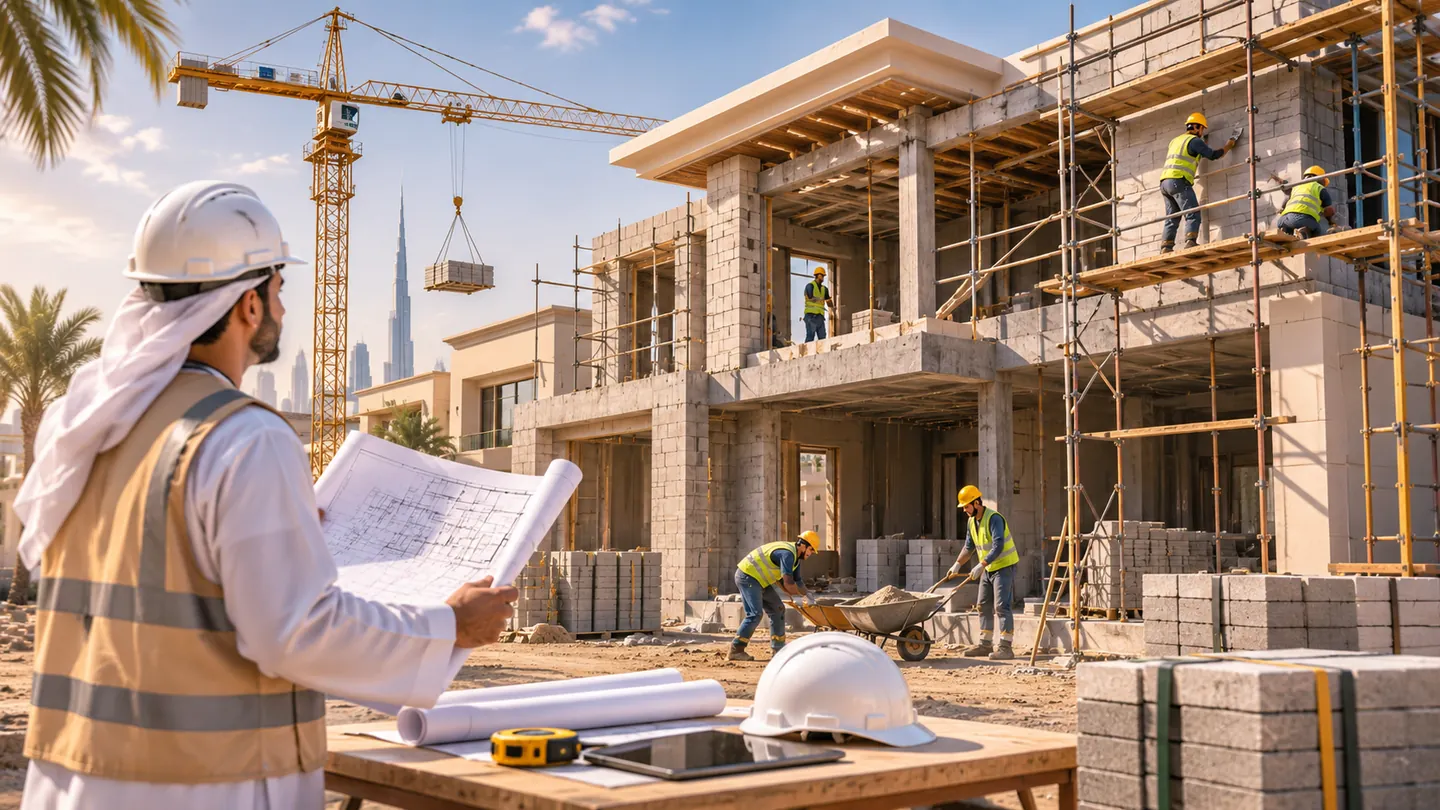
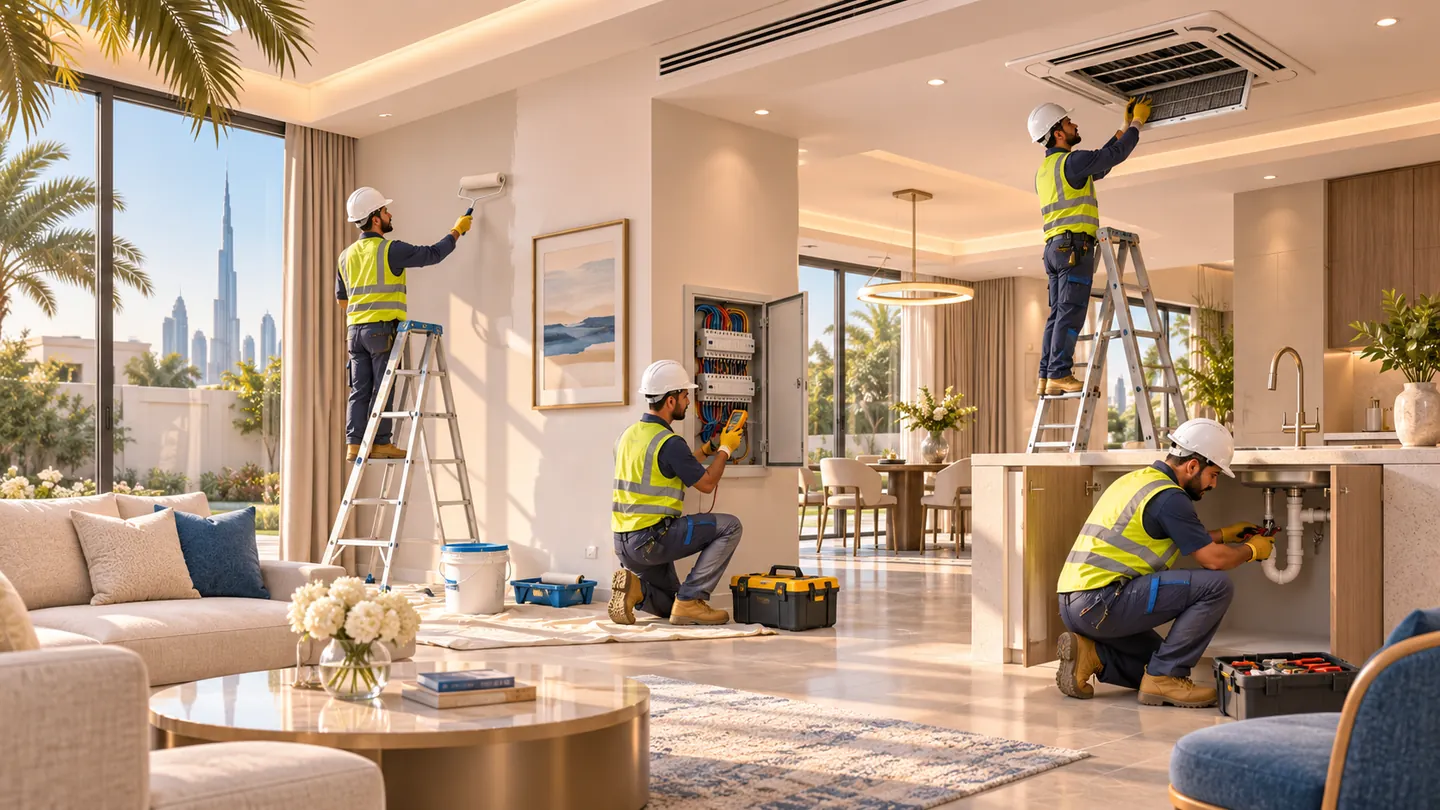
These seventeen construction drafts are provided for guidance and are undergoing editorial review. Confirm project-specific requirements with the competent authority.
In this guide 1. How to select a contractor for a Baniyas building project 2. Finding better-value construction quotes in Baniyas 3. Finding the right builder for your project in Baniyas 4. What to verify before appointing a construction contractor in Baniyas 5. Villa and home builders in Baniyas: planning the project through handover 6. Shell works or turnkey construction in Baniyas: which contract fits? 7. Building majlis extensions, annexes and outdoor rooms in Baniyas 8. What determines the cost of building a villa in Baniyas in 2026? 9. How construction cost per square metre is calculated for a Baniyas project 10. Building approvals and coordinated design documents for Baniyas projects 11. Understanding principal contractors, subcontractors and engineering consultants in Baniyas 12. Comparing building tenders fairly for a Baniyas project 13. Construction contracts, milestone payments and warranties in Baniyas 14. Stages of building a project in Baniyas from site setup to completion 15. Preventing construction defects, delays and contractor disputes in Baniyas 16. Finding contractors with genuine service coverage in Baniyas and nearby areas 17. Preparing a useful construction quotation request for a Baniyas project
1. How to select a contractor for a Baniyas building project Searching for the “best contractor in Baniyas” is really a decision about fit. A contractor experienced in new villas may not be the right team for structural repairs in an occupied building, while a shell-work specialist may offer a very different scope from a firm coordinating complete finishing and building services. Start with the type of project, its current condition, the work packages you want to appoint and the expected outcome. No business should be presented as universally best without defensible evidence and criteria.
Prepare a short project brief: Baniyas site location, available plans, approximate built area from the drawings, current stage, desired work and intended timing. For an extension, include connections to the existing villa and access limitations. For a project that has stopped, an appropriate professional may need to inspect completed work before another contractor can price the remainder. A clear brief makes the quotations more comparable and prevents different assumptions from being hidden under the phrase “complete construction”.
Check that a shortlisted business has the relevant economic activity and, where applicable, engineering classification. The Abu Dhabi Department of Municipalities and Transport publishes an engineering-firm classification search. A valid business licence, a firm's professional eligibility and a project-specific building permit are separate matters. Ask who is responsible for technical design, supervision, specialist subcontractors and site coordination. Online ratings and photographs may be helpful background but should not be treated as government approval.
Evaluate relevant work rather than marketing volume. Ask for examples of projects of similar type and size, and clarify which elements were delivered directly or through subcontractors. With the previous client's permission, verifiable references may help identify how changes, delays and handover issues were managed. Photographs of a completed façade cannot show concealed waterproofing, electrical safety or the quality of inspections during construction.
Invite quotations against the same drawings and quantities. Each proposal should identify material grades, work descriptions, programme, payment milestones, required testing, warranties and exclusions. A Baniyas majlis quote that covers only the structure and paint cannot be compared directly with one that also provides glazing, air-conditioning, drainage and external connections. Have significant technical differences checked before deciding that one bidder is cheaper.
Ask about the practical delivery plan. Who supervises trades, procures and stores materials, protects the occupied parts of the villa and manages safe site access? How are inspections arranged before work is concealed? The payment schedule should reflect verifiable progress. Changes should be documented with their effect on costs and timing rather than settled through informal instructions on site.
A sensible selection process weighs relevant experience, regulatory suitability, quality controls, scope clarity, schedule and total expected cost. The lowest number may be appropriate when it includes everything required, but a slightly higher proposal may be more dependable if its risks and assumptions are documented. Use the local specialty directory to discover genuinely published providers, confirm Baniyas coverage and request a site-specific quotation.
2. Finding better-value construction quotes in Baniyas The cheapest construction quote in Baniyas is not necessarily the lowest final cost. An unusually low proposal may exclude waterproofing, testing, external services, site protection, delivery or finishing works. It may also assume a different product grade or that the owner will supply key materials. Compare the total cost of achieving the required specification rather than the opening number on the front page of a quotation.
Give all shortlisted contractors the same plans, work scope and measurement basis. State whether the project is shell-only, shell-and-core, finishing or complete handover. Where the design remains unresolved, treat offers as estimates with stated assumptions. Existing villas, extensions and occupied sites can have additional protection, access and sequencing needs. These factors should be included rather than discovered after the contract is signed.
Use a bill of quantities or a consistent item schedule where possible. For structural work, compare ground preparation, foundations, concrete, reinforcement, blockwork and the connection to existing construction. For finishing, check flooring, plastering, paint, joinery, glazing, electrical services, plumbing, AC and waterproofing. A line reading “extra work as required” is not a measurable commitment; ask what triggers additional work and how it will be valued and approved.
Do not compare only broad product labels. “Premium paint” or “good tiles” may refer to different systems and grades. Record manufacturers or performance specifications where appropriate, preparation methods, samples and warranties. Cost savings can come from reducing unnecessary design complexity, coordinating procurement and limiting waste. They should not come from omitting essential safety provisions, inspections or professionally approved requirements.
Transport, unloading, specialist equipment and waste removal can change the real cost. A quote may also omit the effects of a delivery delay or the responsibility for owner-supplied materials. Prepare a comparison sheet that includes these matters along with testing, handover and reasonable defect follow-up. If one company proposes a shorter programme, ask what labour, procurement and inspection assumptions support it.
A well-written agreement helps protect a competitive price. Define milestone payments and the evidence required at each stage, the method for approving variations, and the process for recording delays and changes. Avoid treating a large advance payment as a cost-saving strategy without examining the related risk. If the owner changes specifications during construction, request a written assessment of timing and price before authorising the change.
There is no reliable permanent ranking of the cheapest contractor for all Baniyas projects. Prices depend on scope, drawings, materials, location and timing. The practical goal is a complete, transparent offer that can be delivered, inspected and handed over without unbudgeted omissions.
3. Finding the right builder for your project in Baniyas Finding a builder in Baniyas begins with a defined project, not a random list of telephone numbers. A new villa, a detached majlis, completion of an abandoned structure and repair of structural defects require different skills and different information. Record the property type, project stage and intended work. If drawings exist, issue the same current drawing set to every bidder; prices based on different revisions cannot be fairly compared.
Use the relevant Biet Al Reef directory category to discover businesses, then check the services actually listed and whether the company covers Baniyas. An Abu Dhabi office address does not guarantee a team can attend at the required time. Ask whether the firm will act as principal contractor coordinating several trades or whether you must engage each trade yourself. Responsibilities for scheduling and site protection differ considerably between those arrangements.
Before shortlisting, verify business activity and, where applicable, engineering classification through the competent public sources. A commercial licence, engineering classification and project-specific permit are separate matters. Photographs, testimonials and social media popularity can help you form questions, but they do not replace official checks. Ask who will supervise the site and communicate with the consultant or owner during construction.
Send identical information to every candidate: a description of works, available drawings, quantities, site photographs, access constraints, preferred finishes and intended programme. Require a written list of inclusions and exclusions, material assumptions, key milestones, payment stages and warranty conditions. A contractor may include temporary works or utility coordination that another has excluded; this can make a cheap headline price misleading.
Arrange a survey when the site conditions cannot be understood reliably from documents. In an occupied villa, discuss safe separation of construction areas, deliveries, dust, noise and access for residents. On an undeveloped plot, establish what site investigations, ground works, temporary utilities and external connections are outside the contractor's scope. Structural alterations should follow appropriate professional assessment and any required approvals, not an informal instruction.
Finally, compare equivalent tenders. Separate the firm price from options, provisional allowances and unresolved risks. Ask bidders to explain material differences and establish how variations will be documented. An appropriate builder is not simply the fastest or least expensive: it is a company with relevant capability, an intelligible scope, workable supervision, a clear programme and an accountable handover process. Preserve the final written offer and clarifications as part of the contract record.
During the search, pay attention to how the company handles clarification requests. A contractor who can explain a disputed quantity, identify the version of a drawing used for pricing and issue a revised written offer gives you evidence of its project administration. Record each site visit and any assumptions agreed afterwards. If quotations arrive through messaging applications, store the final files and dates in one place rather than relying on a long unstructured conversation. Ask who will issue the definitive offer and whether it supersedes previous estimates. These habits make it easier to identify mistakes before they become contract disputes.
4. What to verify before appointing a construction contractor in Baniyas Selecting a contractor for a Baniyas project involves more than cost: the decision affects building safety, programme and the owner's financial exposure. Assess three separate questions. Is the business eligible for the relevant activity? Does it have credible experience and resources for this type of work? Does the proposed contract allocate responsibilities clearly? A familiar name or a single certificate cannot settle all three.
Request the economic licence details and check that the contracting entity named in the agreement is the entity whose records are being reviewed. For regulated engineering work, consult the Department of Municipalities and Transport's current engineering-firm classification service. Classification depends on the specific activities and categories; it is not interchangeable with an economic licence or a building permit. Avoid assuming that a generic staffing or capital requirement applies to every contractor.
Experience should be relevant rather than decorative. Ask for evidence of projects with comparable structural work, extensions, remedial work or fit-out requirements. Clarify which tasks were performed by the firm and which were subcontracted. Identify who coordinates the trades, deals with the engineer's comments and is answerable for correcting defects. An owner should not need to negotiate directly with several unrelated site crews to establish basic accountability.
Ask how labour, equipment, inspections and material deliveries will be sequenced. Interfaces between waterproofing, plumbing, electrical work, air conditioning, ceilings and finishes are common sources of later disputes. For work alongside an occupied villa in Baniyas, arrange safe access, storage, dust protection and working hours. Requirements concerning site safety, waste handling and access need to be checked against the actual works and applicable rules.
A sound financial proposal identifies inclusions, exclusions, quantities, allowances, testing and handover responsibilities. Payments should correspond to demonstrable progress, and variations should be authorised in writing with a recorded effect on price and time. Distinguish a product manufacturer's warranty from the contractor's workmanship obligations. Ask what happens if the programme slips, parties disagree over quality or the works are suspended.
Before signing, check the agreed drawings, specifications, programme, inspection points and dispute process. Depending on the size and complexity, professional review of the final contract may be valuable. The test is not whether a salesperson calls the company “excellent”, but whether its eligibility, comparable work, staffing, supervision, tender detail and warranty terms can be verified and understood. Unanswered questions should be resolved before work begins.
Assess whether each promise can actually be fulfilled. A very short programme should be supported by an explanation of sequencing, labour, procurement and the timing of consultant inspections. A long warranty is meaningful only when the company explains the covered work, exclusions and how a defect will be reported and assessed. For concealed services and waterproofing, request the appropriate inspection and test records before surfaces are closed. Ask which project documents the contractor will deliver at completion and who keeps revision records. These checks turn broad claims into accountable commitments that can be assessed during construction and at handover.
5. Villa and home builders in Baniyas: planning the project through handover Building a villa in Baniyas begins with a household brief, not with a contractor arriving on site. Consider room use, majlis arrangements, parking, storage, access, outdoor space and future maintenance. The design team must then develop drawings suited to the particular plot and applicable requirements. A plot's area alone is not a reliable measure of construction cost: built area, structure, specifications, finishes and utility interfaces all matter.
Understand the division between consultant and contractor. Depending on the appointment, a consultancy may develop coordinated drawings, support approvals and supervise work. The contractor undertakes agreed construction tasks, trade coordination and supply. For meaningful tenders, issue current drawings, specifications, site information and quantities where available. An architectural picture is not sufficient evidence of the works or systems required.
Shortlist firms with relevant experience across the phases you intend to procure. Ask who undertakes ground and structural work, who coordinates electrical and mechanical services and who checks waterproofing before it is concealed. A principal contractor can provide a single coordination point, whereas multiple separate contracts require the owner or appointed manager to control interfaces. Neither route should leave responsibility ambiguous.
Construction commonly progresses through site preparation, ground and foundation work, structure, enclosure, services, waterproofing and finishes, but a real programme should follow the approved project and may contain overlapping activities. Establish inspection points for work that will be covered by concrete, ceilings or tiles. Keep approved drawings, revisions and test records traceable. Material substitutions need proper review rather than informal approval from whichever trade is available on site.
Practical details deserve early attention: sockets, air-conditioning access, surface drainage, vehicle movements, shade, maintenance clearances and construction storage. In Baniyas, actual site access and neighbouring occupancy should shape delivery plans and temporary protection arrangements. A late decision to introduce a detached majlis or external kitchen can affect underground services, time and cost, even where the addition appears visually simple.
Handover is not just receiving keys. Agree a completion checklist covering windows, doors, electrical and plumbing systems, drainage, cooling, waterproofing and finishes. Record defects, the responsible party, agreed correction dates and subsequent inspection. Request the documents, operating instructions and warranty information required by the contract and any applicable authority process. A good villa contractor plans for verifiable completion from the first tender, rather than treating the final inspection as an afterthought.
Owners, consultants and contractors should also agree when samples and selections become final. A late change to tile thickness, glazing systems or kitchen dimensions can affect several trades and disrupt procurement. Request a decision schedule that shows which selections are needed before manufacturing or installation and how delays will be reported. Identify the status of boundary walls, hard landscaping, access paving, parking and outbuildings; these are not automatically included in every villa building contract. At completion, test equipment, switches, doors and drainage under ordinary operating conditions rather than relying only on visual inspection. Keep the inspection findings alongside the snagging and rectification record.
6. Shell works or turnkey construction in Baniyas: which contract fits? “Shell construction” and “turnkey” do not have one universal bill of works. A shell tender may include foundations, structure and blockwork but exclude waterproofing, service provisions or even some external works. Turnkey does not automatically include furniture, appliances, landscaping, authority fees or utility connections. Ask for a written scope and a precise definition of the condition in which the property will be handed over.
Under a shell-only arrangement the owner will usually procure several later packages for mechanical, electrical, plumbing, finishes and fitted elements. This offers greater choice in products and contractors but increases the need for coordination. The finishing contractor must be able to work from accurate drawings and receive properly inspected structures and service interfaces. Otherwise, rework and disputes over who caused a defect can become expensive.
A turnkey agreement places a broader delivery scope with one contracting party, but the owner still needs to review the material schedule, brands or technical grades, sample approval procedure and exclusions. Ask who controls specialist subcontractors, how products are substituted, whether client changes will be separately priced and which finishing level is assumed. An attractive rendered image cannot replace a written schedule of finishes and coordinated drawings.
Compare both options against the complete project, not the initial contract value. Prepare a matrix for foundations, structure, envelope, waterproofing, windows, services, tiling, decoration, joinery, external works, commissioning and final cleaning. Mark who supplies, installs, inspects and warrants each item. If you engage a shell contractor, establish an inspection and close-out process before another contractor begins finishing work.
Site conditions in Baniyas can affect the contract boundaries. A project next to an occupied villa needs safe separation, storage and access; a plot awaiting construction may require temporary arrangements. If a detached majlis, external kitchen or covered parking is planned, agree whether it is included and how it connects to the main building's services. Early choices about finished levels and openings can affect structural and installation work.
Neither procurement approach is automatically better. An owner with experienced coordination support may prefer separately managed stages; another may benefit from one clearly accountable contractor. In both cases, agree payment milestones, inspections, required permits and handover records. Most importantly, distinguish the total expected cost from a partial tender figure and do not sign until you can explain who owns every major interface.
If work will be split, have the consultant document the interface between stages. For example, who owns a clash between an air-conditioning duct and a structural beam discovered after the shell is handed over? Identify setting-out levels, openings, embedded services, and inspections that must be completed before finishes conceal the work. Agree what records the next contractor receives, and who pays for correcting nonconforming work. A staged procurement strategy succeeds when those responsibilities are stated before any dispute arises, not reconstructed from messages after a problem is found.
7. Building majlis extensions, annexes and outdoor rooms in Baniyas An extension, detached majlis or outdoor room in Baniyas needs a use brief before it needs a façade design. Is the space intended for guests, living accommodation, cooking or storage? Will it be attached to the villa or separate? Access, privacy, ventilation, cooling, drainage and service connections follow from those decisions. Planning conditions must be checked for the specific plot and proposal rather than assumed from neighbouring properties.
Gather available land and existing-building drawings and ask an appropriate consultant to assess how the addition interacts with the original structure. An attached extension may affect openings, waterproofing, structure or safety provisions. A separate building needs coherent routes for electrical power, water, drainage and movement between structures. Do not remove an existing wall or dig beside foundations based on a contractor's casual assurance.
A practical majlis design considers guest numbers, seating arrangement, entrances, washrooms, service areas, acoustic comfort and air-conditioning access. Material choices should account for cleaning, sunlight, weather exposure and maintenance. Check thresholds, levels, external paving and roof drainage so rainwater and wash water are not directed into the new room. These functional issues deserve attention before decorative finishes are selected.
Ask the contractor to distinguish design and approvals from construction. The offer should identify excavation, structure, enclosure, waterproofing, electrical and mechanical systems, plumbing, finishes, doors and windows, as well as any connections to the existing house. External kitchens, shades or cooking facilities may bring additional specialist considerations. Furniture, equipment and fixed decorative pieces should be expressly included or excluded in the scope.
For an occupied villa, agree working hours, secure separation of the site, delivery routes, waste management and the treatment of existing utilities. Protect family privacy and plan temporary interruption of services. Ask when drawings and finish samples will be approved, and record any changes before fabrication or ordering. A late change to a window or roof drain can affect several trades, not just one visible item.
Handover should include operating checks for cooling, lighting, water and drainage, examination of doors and windows, and inspection of relevant waterproofing and exterior connections. List defects and agreed correction dates. Test the space in realistic use, including seating circulation and access to service areas. The goal is a safe and maintainable addition that works with the existing villa, not simply a room that looks finished in photographs.
Think about future servicing before approving the layout. Can technicians reach the air-conditioning plant, electrical distribution and roof drainage without entering private living spaces or creating unsafe access? Will large glazed doors be easy to shade, secure and clean? Plan storage for hospitality equipment and cleaning supplies and consider how the space functions during busy gatherings. Discuss any external lighting and paths connecting the new room to the main house. Such decisions rarely dominate a presentation image, but they determine how well the annex serves the household for years.
8. What determines the cost of building a villa in Baniyas in 2026? There is no single defensible price for building every villa in Baniyas in 2026. Plot area and built floor area are not the same, and design, levels, number of floors, structural solution, soil conditions, services, finishes and external works all matter. A house with several annexes, a lift and extensive custom glazing will not cost the same as a simple layout of comparable floor area. An unqualified price per square metre is therefore only a question starter, not a dependable budget.
Break the project into cost groups before comparing tender totals. Depending on the brief, these may include professional design, surveys and approvals, enabling works, foundations, structure, envelope, waterproofing, mechanical and electrical systems, interior finishes, fitted joinery, connections and external works. Identify which are included, excluded or allowed provisionally in each contractor's offer. An apparently cheap tender can be expensive if major packages have been left out.
Design choices affect cost well before procurement. Large openings, complex elevations, specialist windows and bespoke stone or joinery can require more coordination and different products. Set realistic material specifications and decide which items must meet a fixed standard and where alternatives are acceptable. Avoid descriptions such as “premium finish” without a measurable product or workmanship requirement.
Programme and logistics also have a cost. Restricted access, limited storage, special lifting, specialist labour and long-lead materials may change how the work is priced. Ask how transport, unloading, temporary facilities, protection and testing are handled. Two Baniyas plots can have different practical conditions even when their dimensions are similar. Site-specific assumptions are more useful than a generic neighbourhood rate.
To interpret a price per square metre, establish which area is used and precisely what is included. Shell construction, finishes-only packages and turnkey construction produce different figures. Ask whether staircases, covered external spaces, annexes and utility connections are part of the calculation. An early figure should be presented as a range subject to design development and site information, not as a fixed market quotation.
For a dependable estimate, issue a consistent package of drawings, specifications and available quantities to qualified bidders. Compare detailed responses, allowances, exclusions, programme, payment stages and warranty terms. Work with the consultant to identify unresolved risks and agree how variations will be authorised. The useful question is not merely “What is the cheapest rate?” but “What will the complete, inspected and handed-over project cost under this agreed scope?”
Operating cost matters alongside construction cost, but future savings should not be accepted as automatic. A more expensive glazing, insulation or cooling system may be justified by verified performance, maintenance and expected life; another option may offer little benefit for the actual design. Ask the relevant professionals to explain the assumptions behind energy and maintenance estimates and to check that the selected products suit the approved specifications. Keep these lifetime considerations separate from the fixed construction tender so initial price, future service obligations and uncertain predictions are not confused.
9. How construction cost per square metre is calculated for a Baniyas project A construction rate per square metre is meaningful only after both “area” and “scope” have been defined. Plot area is not built-up area; architectural schedules may distinguish floors, annexes and covered outdoor spaces. Ask the consultant for a consistent area statement based on current drawings. Do not infer floor area from plot documents or photographs.
A shell rate, a finishes rate and a turnkey rate cover different work. A contractor may include temporary works and service connections while another excludes them. Compare what each quoted rate actually contains: structure, envelope, waterproofing, mechanical and electrical systems, joinery, finishes, external work, testing and handover. Two equal-looking numbers can describe very different contracts.
Design affects a rate as well as size. Irregular plans, larger structural spans, specialised glazing, roof complexity and soil conditions can change quantities and installation methods. The specification of insulation, cooling systems, bathrooms, kitchens and façades also matters. Once the design progresses, a measured bill of quantities is a more dependable basis than applying one rate to the whole villa.
When given a rate over the phone, ask for the assumed drawings, material quality, date, units, taxes, deliveries, testing, programme and exclusions. A neighbour's project may have omitted items you intend to include. Check how changes to products or finishes are approved and whether any price allowances are provisional rather than firm.
For a Baniyas villa, separate design and approvals, structure, services, finishes, outdoor works and completion activities. Record items that cannot yet be priced accurately as unresolved rather than disguising them in a supposedly final rate. If a detached majlis or other annex is added, update the relevant quantities and services rather than simply applying the original rate to a different building type.
The rate is an early estimating tool, not evidence that a builder is cheap or good. Compare contractors against identical drawings and specifications, capture every exclusion and assess the full handover obligation. The owner should be able to explain how the total was assembled and what may legitimately change it during construction.
Some costs are not proportional to floor area. A kitchen, plant room, utility panel or detached annex may require fixed equipment or separate service connections regardless of the main building's size. If the contractor offers a lump sum, request a breakdown of the major work groups and the rules for adjusting the price if the design changes. Keep allowances separate from committed quantities, and understand which price movements are covered by the contract. This makes the square-metre figure a transparent estimating reference rather than a shortcut for unexplained additions.
10. Building approvals and coordinated design documents for Baniyas projects Before building a villa or annex in Baniyas, distinguish the contractor's economic licence, engineering classification where applicable and the permit associated with the particular project. None replaces the others. The relevant process begins with land information, the intended development and the work type, followed by an appropriate professional appointment to prepare and coordinate the submission.
Depending on the project, drawings may include plans, elevations and sections; structural information on foundations and load-bearing elements; and coordinated electrical, air-conditioning, plumbing and drainage documents. A new villa, alteration to an existing structure and minor non-structural refurbishment do not necessarily require identical submissions. Ask the consultant to identify what is needed for your actual case.
Coordination matters before tender and construction. A service duct passing through a structural element or a bathroom moved after drainage design can create serious rework. Maintain a register of drawing revisions, approvals and unresolved queries. Do not issue an early concept for construction or imply that an attractive 3D view is a professionally approved technical drawing.
Abu Dhabi's Department of Municipalities and Transport and the government Binaa services provide official pathways and information for engineering and building processes. Current documents and requirements should be checked at application time. Plot setbacks, heights and other controls must be confirmed for the actual land and proposal; a figure taken from another property or outdated guide may be inapplicable.
Clarify the consultant's and contractor's respective roles in processing comments and obtaining any permits or revisions. If a structural opening, annex size or other material design change is proposed during work, ask whether revised design and authority review are required before implementation. Maintain a traceable set of approved instructions and inspections.
Approvals protect both project owner and contractor by establishing what may be built and what needs to be verified. Keep licensing checks, permit documents, approved drawings, correspondence and site tests organised. For a reliable answer about a current requirement, use the competent government service or the professional handling your application rather than a generic online claim.
A paused or partially completed project requires special care. Previous approvals and drawings may not describe what is currently built, and a new contractor should not inherit hidden defects without a documented assessment. Ask the appointed professional to compare the existing works with the applicable approved information, identify tests or opening-up inspections and advise whether fresh submissions or amendments are necessary. Record any required corrective work separately from the new construction package. This protects the project owner and helps incoming contractors price a realistic responsibility rather than relying on an incomplete history.
Government references Check the Binaa government platform for project procedures and the DMT list of classified engineering firms where firm eligibility needs verification. Requirements depend on the project and must be confirmed with the competent authority. Links reviewed 6 November 2026.
11. Understanding principal contractors, subcontractors and engineering consultants in Baniyas A Baniyas project can involve several organisations whose titles are familiar but whose responsibilities are unclear. A principal contractor normally agrees a principal scope with the owner and may appoint specialised subcontractors. A subcontractor undertakes a defined package under its own contractual arrangement. An engineering consultant may be appointed for design, professional review or supervision. The specific legal and practical duties depend on the appointments and applicable rules, not on titles alone.
When a principal contractor undertakes a whole villa, the owner needs a clear point of accountability for coordinating structural work, services, waterproofing and finishes. Specialists may carry out work, but the programme should identify who checks their interfaces and handles corrections. Ask how subcontractors are selected, how completed work is protected and who schedules inspection before concealed elements are covered.
Owners who procure shell, services and finishes separately may gain more control over suppliers but must manage the interfaces. If plumbing installation requires an opening in an existing structural element, who reviews the change, approves the design and bears the associated cost? A coordination process and appropriate professional oversight are important. Simply having multiple trades on site does not create an effective construction management system.
A consultant is not automatically the builder. An appointment may include drawings and technical comments but not continuous site supervision. Review the consultant's deliverables, attendance, reporting and authority to approve changes. Professional design decisions and regulatory matters should follow the correct channels rather than informal direction from workers or suppliers.
Consider a detached majlis in Baniyas. An engineer prepares drawings; the principal contractor builds the structure; aluminium and AC specialists install components; and furniture is supplied later. If the window opening or weather seal is wrong, where does responsibility lie? Define measurement, fabrication approvals, installation interfaces and testing responsibilities before ordering.
Prepare a responsibility matrix for every major package. Record who designs, supplies, installs, inspects and warrants it, and who authorises changes to price and time. Use dated drawing issues and written site instructions. At handover, collect test records, warranties and documents from all responsible parties in one organised record so that future maintenance is not obstructed by uncertainty.
Decision authority is another important interface. Who requests procurement, who approves a substitute when the specified product is unavailable and who accepts work before it is concealed? A supplier should not independently change an engineering specification, and a contractor should not accumulate variation costs without notification. Maintain a clear approval trail with drawing revisions, samples and inspection notes. When disagreements arise, review the contractual scope and accepted records rather than relying on competing recollections. This prevents scope being shifted informally from one party to another and supports fair resolution.
12. Comparing building tenders fairly for a Baniyas project Construction tenders should not be ranked by headline totals until they describe the same works. Ask every bidder to price the same current drawings, specifications, site information and quantities. For an extension or renovation, describe existing conditions and access restrictions. Otherwise, one company may assume an empty plot while another prices occupied-site protections, and their offers are not comparable.
Build a comparison schedule around the project packages: preparation, ground works, structure, enclosure, waterproofing, glazing, building services, finishes, joinery, external works, tests and handover. Mark every item as included, excluded or provisionally allowed. An omitted item does not become free simply because its cost is missing from the tender.
Specifications matter as much as quantities. A vague promise of “high quality” tiles or windows is not equal to an offer naming measurable grades and performance requirements. Record acceptable substitutions and approval responsibilities. Where materials or methods are specified by the professional design team, replacement requires appropriate review rather than a price-driven decision by a single supplier.
Examine the programme and payment stages. Do the dates allow for sample approvals, specialist fabrication and inspections of concealed work? Does the contractor include temporary utilities, site protection, waste removal and final cleaning? If part of the Baniyas property remains occupied, clarify how people, deliveries and work areas will be separated safely. The same site assumptions must apply to each tender.
Request a written clarification schedule for exclusions, uncertain quantities and potential variations. Completion of a stalled building may require investigation before certain work can be priced firmly. A suspiciously low offer deserves questions, not an automatic rejection or acceptance. A higher offer may include valuable testing, coordination or warranty obligations; compare what these actually mean.
Keep the final scope, tender revisions, correspondence and accepted exceptions together. The selected contractor should be able to explain what it will deliver, how the cost was assembled and how changes will be agreed. An economical offer can be appropriate when complete and feasible. The winning factor is a verifiable proposition, not merely the smallest number on a quotation sheet.
Before signing, hold a clarification meeting with the preferred contractor and the supervising professional where appointed. Confirm outstanding assumptions, responsibility for specialist procurement and the drawing issue to be used for construction. Convert broad assurances such as “all works included” into a traceable written schedule. Record unanswered questions and the date by which they must be resolved. Ask the bidder to identify any items priced as provisional allowances and how final quantities will be valued. This last review is especially valuable where several bids appear similar on price but leave very different liabilities with the owner.
13. Construction contracts, milestone payments and warranties in Baniyas A useful building contract for Baniyas does more than name the contractor and price. It identifies the parties, site, work scope, governing drawings and specifications, programme, payment mechanism, changes and handover. For an extension or completion of an interrupted project, record the existing condition and what the new contractor is not accepting responsibility for without assessment.
Describe the work in measurable terms. Phrases such as “premium finishing” or “complete villa” are insufficient without material grades, workmanship requirements and scope boundaries. Establish who buys products, approves samples, stores goods, protects existing work and coordinates trades. For a complex or high-value project, appropriate professional review of the contract can help identify missing obligations.
Payments should correspond to verifiable milestones rather than dates alone. Agree what constitutes completion of each stage, which inspection records are needed and who certifies or accepts the work. Avoid paying for unverified tasks while also providing a fair process for release of properly due payments. The exact schedule should fit the project, not a generic template.
Changes require an agreed procedure. Record the reason, description, revised price, effect on completion and any design or authority implications before work proceeds. A photograph sent in a chat is not a sufficient substitute for clear approval of cost and responsibility. Maintain a register of drawing revisions, quantities and site instructions so neither party relies on memory after several months.
Different warranties may apply to manufactured products, installation workmanship and other contractual or statutory obligations. State the coverage, duration, exclusions and reporting process for each. Air-conditioning, joinery, waterproofing and structural work do not necessarily have identical arrangements. Agree which test records, manuals and certificates will accompany completion.
Handover should be documented through inspection, a snag list, correction dates and agreed acceptance. Keep payment records, variations, final drawings, invoices and warranties together. If disputes arise, those documents provide a traceable basis for determining what was agreed and delivered. Clear contracting protects both owner and builder from unfair assumptions outside the accepted scope.
When a payment relates to work the owner cannot easily inspect, such as waterproofing before backfilling or services above a ceiling, specify the supporting record required from the competent supervisor. Keep the payment process aligned with the agreed inspection and approval channels. Define who may instruct urgent work, who approves its cost and how it is recorded afterwards. The final account should reconcile the original contract, authorised changes, paid amounts and outstanding obligations. It is easier to agree these rules before the work begins than to reconstruct them under the pressure of a completion deadline.
14. Stages of building a project in Baniyas from site setup to completion Understanding construction stages helps a Baniyas owner make decisions at the right time. Design and approvals ordinarily precede site work, followed by preparation, ground works, structure, enclosure, services, waterproofing, finishes, testing and handover. This is a guide rather than a substitute for the contractor's approved programme; activities may overlap and particular projects require different sequences.
Site setup should establish access, working areas, storage, levels and protection of surrounding property. An extension to an occupied villa requires separation from family areas. Ground and foundation work follows the relevant design and investigation, with appropriate checks before concrete or backfilling conceals important elements. Retain records of inspections and conditions that future teams cannot see.
During structural work, coordinate openings and the routes of electrical, plumbing and cooling services. A conflict discovered after a slab or wall is complete may be expensive to rectify. Use current controlled drawing issues and refer structural changes to the responsible professional. Review door, window and floor level interfaces before the fabrication and finishing trades arrive.
Enclosure, waterproofing, building services and finishing work then progress in a coordinated order. Tests should be completed when work is accessible, before relevant systems are hidden by ceilings or tiling. Approve finish samples and product specifications before procurement. When the owner requests a different layout or material, document its effect on cost, programme and other trades.
Overlapping activities can improve efficiency but should not remove required inspection opportunities. Exterior works, parking, walls and landscaping need coordination with drainage and buried services. Actual site access and material handling in Baniyas should be reviewed rather than assumed from the neighbourhood name.
At completion, conduct operating checks for cooling, lighting, electrical fittings, sanitary fixtures, drainage, doors and windows as applicable. Record snags and correction responsibilities. Collect manuals, test records, warranties and required drawings. Understanding the stages helps the owner follow progress and payments while leaving specialist technical judgments to qualified professionals.
Keep an owner-decision schedule alongside the construction programme. Some samples can wait, while delays in selecting windows, tiles, kitchens or specialist equipment may hold up fabrication and downstream trades. Ask for the date by which each choice must be made and the documented consequence of a late decision. When inspection identifies nonconforming work, establish which activities may proceed safely and which must be held until correction and reinspection. A useful programme explains dependencies, responsibilities and decisions, not just a series of coloured bars or optimistic completion dates.
15. Preventing construction defects, delays and contractor disputes in Baniyas Many construction disputes begin before site work. An owner signs against vague specifications, uses uncoordinated drawings or authorises changes informally, and later neither party can prove the agreed scope. Keep a controlled file containing the contract, drawings, specifications, programme, inspection points and payment arrangements. Messages may help communication but should not replace dated decisions.
A common mistake is accepting the cheapest incomplete tender. Compare identical scopes, record exclusions and confirm material grades. Stalled construction needs assessment of existing works before a new firm assumes responsibility. Avoid treating unknown defects as either the incoming contractor's automatic liability or the owner's problem without an evidence-based review.
Trade coordination is critical. Building services may clash with structure, concealed waterproofing may go untested and fabricated windows may not fit the finished openings. Set inspection holds and verify shop drawings before work is concealed or products are ordered. Structural changes require appropriate professional review; a verbal suggestion from a worker is not a controlled instruction.
Delays can arise from slow selections, supplier constraints, design changes or inadequate labour. A meaningful programme identifies dependencies and decisions needed from both owner and contractor. When a milestone slips, ask for the cause, the effect on later works and a realistic recovery proposal. A new promised date means little without evidence of resources and materials.
In Baniyas, work beside an occupied villa may create access, safety, noise and property-protection disputes. Record the condition of existing finishes, establish protected routes and agree which areas will be reinstated. Variations should identify cost, time and technical consequences before approval. Keep a current list of instructions rather than relying on several incompatible versions.
If a dispute arises, first establish the facts: approved drawing issue, work performed, tests, changes and payments. Seek appropriate professional assessment of technical matters and follow the agreed dispute process and applicable legal channels as necessary. At handover, record defects and correction deadlines. The aim is a documented and fair resolution rather than unsubstantiated blame.
A short risk register is a practical prevention tool. Identify long-lead materials, decisions awaiting owner approval, inspections that must not be missed and interfaces between trades. Give each item an owner, a deadline and a clear closure action. Review the list at regular progress meetings, and do not allow unresolved critical items to disappear under a revised programme. A documented early warning process provides both parties a fair opportunity to prevent loss rather than simply debating blame after a deadline has passed.
16. Finding contractors with genuine service coverage in Baniyas and nearby areas A contractor with an office in Abu Dhabi City does not necessarily have an available team in Baniyas, while a business based elsewhere may legitimately serve the area. Separate office address from published service coverage and practical attendance. Begin with the correct Biet Al Reef specialty and examine the business profile and declared work types before requesting a site visit.
A new villa, structural annex, shell package, remedial project and finishing job may require different firms. Define the project and its current condition so you can shortlist companies with an appropriate activity and experience. Ask who will supervise the actual Baniyas site and whether the team can meet the required programme. Generic advertising claims about serving “all areas” should be confirmed against real availability.
Where engineering classification applies, use the current Department of Municipalities and Transport records to check relevant firm details and activities. The economic licence and any project permit are separate checks. Public listings cannot promise that a firm will be available tomorrow or that it is the best option for every project. Seek comparable work examples and understand the role of the proposed site manager.
Clarify the logistics of attendance: survey date, travel charges, storage or equipment needs, working hours and whether a regular site supervisor will be present. If work takes place beside an occupied home, discuss access restrictions early. Different firms may serve the same region under different commercial arrangements, so availability and scope belong in the quotation.
Prepare a short list based on trade suitability and real coverage, then send every business the same work package. Avoid rankings based on unsupported “best” or “cheapest” claims. If no suitable published company is available, do not assume that an unrelated business can perform the required work. Use the relevant specialty and quotation pathway and check again when publication data changes.
Business profiles become more helpful when they describe actual services, project examples, contact details and coverage accurately. Verification labels, commercial subscriptions and publication status are not interchangeable with contractor engineering eligibility. Clients should still confirm scope, dates and terms directly. An effective local directory provides a route to accountable businesses rather than a list of impressive but unverified names.
A provider able to send a surveyor to Baniyas may not have capacity to manage a villa project for several months. Confirm the proposed mobilisation date, continuity of supervision, expected site-team arrangement and responsibility for decisions when the manager is absent. Ask how the contractor would manage competing commitments if several projects overlap. This is not a demand for confidential internal staffing data; it is a reasonable check that the promised programme has an operational basis.
17. Preparing a useful construction quotation request for a Baniyas project A useful construction quotation request in Baniyas starts with the project type: new villa, annex, majlis, shell structure, renovation, finishing or completion of suspended work. Give the general location and stage of the project and specify whether you want a complete contract or one defined package. Sensitive personal or project documents should be shared through an agreed appropriate channel rather than posted publicly.
Gather the technical information you already have. This may include current drawings, approximate built area, number of floors, photographs of existing work, a work list, material specifications and quantities. If no drawings exist, say so and consider commissioning suitable design advice before demanding a binding construction price. For a stalled project, explain what has been completed and what still needs professional assessment.
Describe the work in packages rather than phrases like “full majlis”. Is the contractor to provide design, approvals, ground work, structure, waterproofing, building services, finishes, windows and doors, exterior works or furniture? Identify which are required and which are not. Where bespoke products are involved, share available measurements, samples or technical specifications.
State the preferred starting period and programme constraints, but invite a realistic proposed sequence that accounts for materials and inspections. A budget indication can help establish feasibility when used sensibly; it cannot replace proper pricing. Describe access arrangements in Baniyas, especially for an occupied property, and offer a suitable window for a survey. Label photographs so the recipient knows which defect or room they show.
Request a written response identifying the contracting company, scope, inclusions and exclusions, materials, quantities or pricing assumptions, programme, milestone payments, warranties, variation procedure and validity of the offer. Some work may remain provisional until site investigation. If a paid survey is necessary, agree its fee and conditions before booking.
Once proposals arrive, compare them consistently and seek clarification of material differences. Preserve the final issue of each proposal and any agreed specification changes. Biet Al Reef's local contracting specialty can help you find published businesses whose declared coverage includes Baniyas. A well-prepared enquiry does not guarantee the cheapest price; it makes professional pricing, fair competition and accountable delivery more achievable.
You can add a short standard questionnaire to the enquiry. Ask whether more drawings or investigations are necessary, when a survey can be arranged, which items cannot yet be priced, who will supervise execution and what handover records are provided. Give bidders the same opportunity to raise technical questions, and record the answers. If the site survey reveals a substantial change, issue a revised description before making the final comparison. An organised exchange helps separate a thoughtful proposal from an automated generic price response.